pool-service
How Much Does Pool Service Cost in Tennessee? What Drives the Quote and What to Budget
Pool service in Tennessee runs $180 to $320 a month. See what drives your quote, hard water costs in Middle Tennessee, and repair and resurfacing budgets.
In This Article
How Much Does Pool Service Cost in Tennessee? What Drives the Quote and What to Budget
Two identical looking pools in the same Nashville, TN subdivision can carry monthly service quotes $90 apart, and the reason usually has nothing to do with which company is greedier. Surface type, equipment age, tree cover, and whether the pool has an attached spa each move the number, and the homeowner comparing two headline figures rarely sees any of it.
Weekly full service across Tennessee runs $45 to $80 per visit, or $180 to $320 a month during the season. Williamson County and the Nashville suburbs sit at the top. Memphis, Knoxville, and Chattanooga run modestly below, and the smaller markets across West and East Tennessee run lower still.
The season here is roughly late April through early October, about 24 weeks. Add an opening and a closing and the realistic annual cost for a standard in-ground pool lands between $2,500 and $4,600 before repairs.
The Four Things That Set Your Price
Surface type comes first. Plaster is the most common finish on Tennessee pools built before about 2005, and it is chemically reactive, meaning it consumes alkalinity and shows staining and etching when chemistry drifts. Pebble and quartz finishes are more forgiving and take less corrective work over a season.
Equipment age is second and it drives more service calls than anything else. A pad with a fifteen year old single speed pump, a sand filter that has never been rebedded, and a heater with a corroded header will generate three or four service calls a summer at $95 to $150 each.
Tree cover is third and it is the variable homeowners underestimate. A pool ringed by mature oaks and sweetgums in Knoxville generates several times the netting and vacuuming labor of an open yard in a newer Rutherford County subdivision, and it also loads the filter faster.
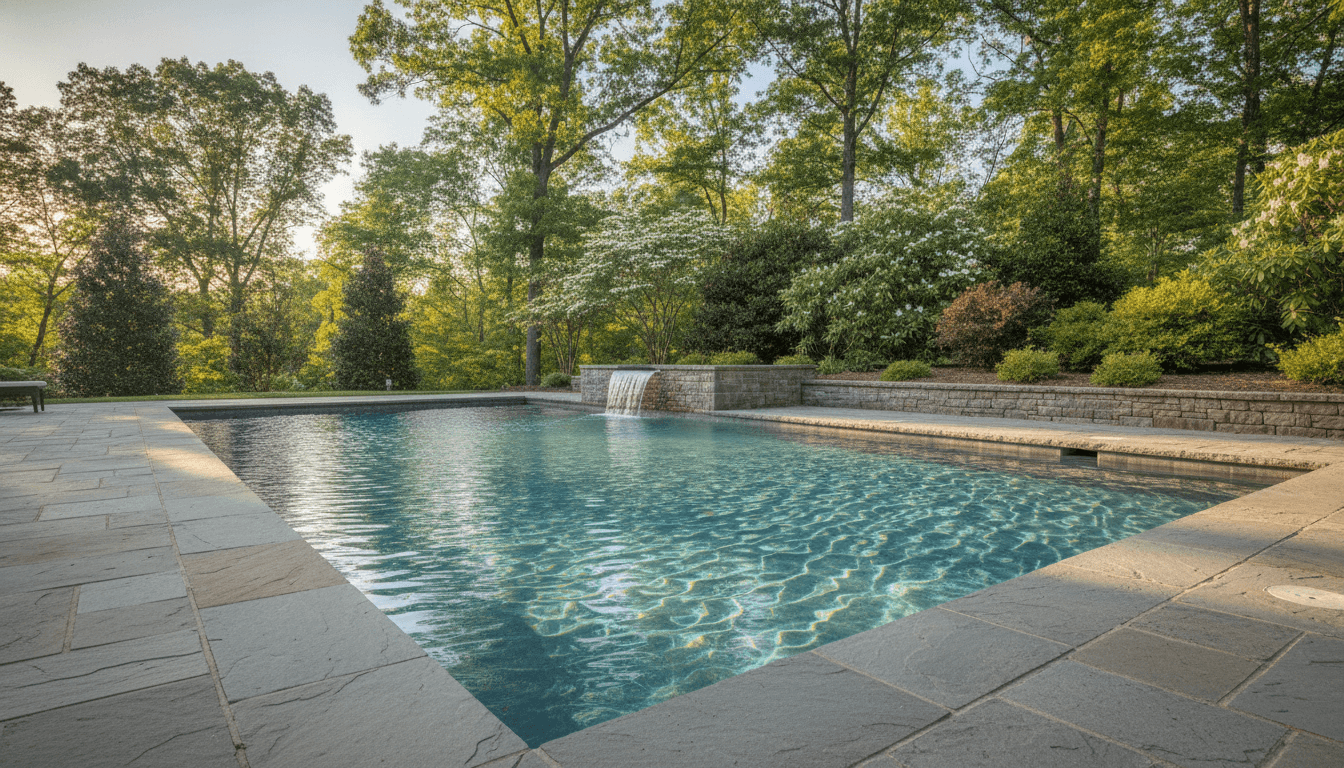
Features are fourth. An attached spa, a tanning ledge, a waterfall, or an in-floor cleaning system each add chemistry points, surfaces to brush, and equipment to check. A company quoting a feature pool at the same price as a plain rectangle either has not seen it or plans to revisit the number.
Service Plans Available in Tennessee
Full service with chemicals included is what most companies here sell as the standard plan. The weekly visit covers water testing and balancing, brushing walls and steps, netting the surface and floor, vacuuming as needed, emptying skimmer and pump baskets, backwashing or cleaning the filter, and an equipment inspection.
Chemical-only service runs $115 to $195 a month and covers testing, dosing, and a basket check. It works for a homeowner running a robotic cleaner in a low-debris yard and it fails under heavy tree cover, which describes much of the housing in East Tennessee.
Biweekly full service saves about 35 percent and holds up in May and September. Through July and August, when water in Middle Tennessee reaches the mid eighties and afternoon storms deliver both debris and phosphates, the two week gap is where algae blooms happen.
Extra Visit Charges to Ask About
Filter cleanings beyond the routine cycle typically run $85 to $175. Storm cleanups get billed hourly at $65 to $110 by companies that do not fold them into the monthly rate, and Tennessee summers produce enough of them to matter.
Ask specifically what happens when the pool needs more than a normal visit. A contract that says the technician will do what is required within the visit window is different from one that bills for every extra fifteen minutes, and the difference shows up in July.
Hard Water, Limestone, and Middle Tennessee Chemistry
Groundwater and municipal supply across Middle Tennessee run through limestone, and the resulting calcium hardness is the defining water chemistry issue in this part of the state. Fill water in the Nashville and Murfreesboro area frequently arrives at 150 to 250 parts per million calcium hardness before any pool chemistry is added.
That matters because calcium accumulates. Evaporation removes water and leaves the minerals behind, so a pool topped off repeatedly through a hot summer climbs steadily, and above roughly 400 parts per million you start seeing scale on the tile line, cloudy water that will not clear, and rough deposits on the heater exchanger.
The fix is partial drain and refill, which costs $150 to $400 in labor plus water and typically comes due every three to five years in Middle Tennessee. Tile line scale removal, when it gets ahead of you, runs $1,200 to $2,600 for a bead blast on an average pool.
East Tennessee water around Knoxville and Chattanooga runs softer, which shifts the problem to the other end. Low calcium water is aggressive toward plaster and will etch a surface over time, so those pools need calcium added rather than removed.
Opening and Closing a Tennessee Pool
An opening runs $325 to $600 and covers pulling and cleaning the cover, reinstalling ladders and rails, reassembling and starting the filtration system, filling to the tile line, and the first shock and balance. Companies in Williamson and Rutherford counties fill their April calendars by early March.
Closing costs $300 to $550 and includes lowering the water below the returns and skimmer, blowing out and plugging the lines, adding antifreeze and winterizing chemicals, pulling the deck equipment, and setting the cover. The line blowout is the part that earns the fee, since a cracked return line under a concrete deck turns into a $2,000 excavation.
Cover choice affects both numbers and affects the spring bill more than the fall one. A mesh safety cover at $2,200 to $4,800 installed keeps debris out and makes the April opening a quick job. A solid tarp with water bags collects a pond of leaf tea that turns the opening into a $700 green pool recovery.
Some Tennessee homeowners run their pools year-round with a freeze protection setting on the controller. That works in the western part of the state more often than in the eastern half, and it depends entirely on the equipment pad being protected and the pump running when temperatures drop.
Repairs and Replacements to Budget For
A variable speed pump replacement runs $1,250 to $2,500 installed. Tennessee summers make the electricity argument straightforward, since a single speed pump on an eight hour daily schedule adds $70 to $140 a month to the bill and a variable speed unit does the same filtration for a third of that.
Filter replacement lands at $850 to $2,200 depending on type. Gas heater replacement runs $4,200 to $8,000 installed, and heat pumps run $4,000 to $7,500 and are the better fit for extending a Tennessee shoulder season.
Salt cell replacement costs $750 to $1,500 every four to six years, and salt systems are widespread across the state. Replastering comes due every ten to fifteen years at $6,500 to $11,500, with pebble finishes running $11,000 to $18,000 and lasting longer.
Vinyl liner pools are common in the older housing across Tennessee, and liner replacement runs $4,600 to $8,500 including water on a ten to fourteen year cycle. Faded color and a liner pulling out of the track at the shallow end corners are the signs you are close.
Screening a Tennessee Pool Company
Tennessee does not license residential pool maintenance technicians. Contractors performing construction or repair work above the state threshold need a contractor license through the Board for Licensing Contractors, and electrical or gas work on the equipment pad requires the appropriate trade license.
Verify insurance rather than assuming. Ask for a certificate of general liability coverage sent from the agent and confirm workers' compensation coverage for the technicians who will be on your property.
Then ask about process. A company that leaves a written service report with chemistry readings after every visit is telling you the work was done and giving you a record to review. A company that leaves nothing is asking you to trust that the technician who was on your property for twelve minutes tested anything.
Comparing three quotes from pool service companies working in your part of Tennessee on identical scope shows you who is padding and who is underbidding. Our Tennessee home service cost guides use the same approach for other trades.
Common Questions About Tennessee Pool Service
How often should a Tennessee pool be drained?
Every three to five years across Middle Tennessee, mainly to reset calcium hardness and cyanuric acid that build up through hot summers with heavy evaporation. A partial drain of 30 to 50 percent handles most cases at $150 to $400 in labor plus the water.
What does it cost to open and close a pool in Tennessee?
Openings run $325 to $600 and closings $300 to $550 for a standard in-ground pool. Winterization here is real, since Middle and East Tennessee both see hard freezes, and lines left holding water can crack under a concrete deck.
Is a salt system worth it in Tennessee?
For most homeowners here, yes. Salt water feels softer, chemical spending drops by $200 to $400 a season, and the cell replacement at $750 to $1,500 every four to six years is a manageable trade. In hard water areas around Nashville, watch the calcium level closely, since salt systems can accelerate scaling.
How much does a green pool cost to clean up?
Standard green-to-clean recovery runs $350 to $850 over four to seven days with shock, algaecide, brushing, and repeated filter cleaning. A pool that sat through a July heat wave without service and turned dark may need a partial drain, pushing it toward $1,200 to $1,700.